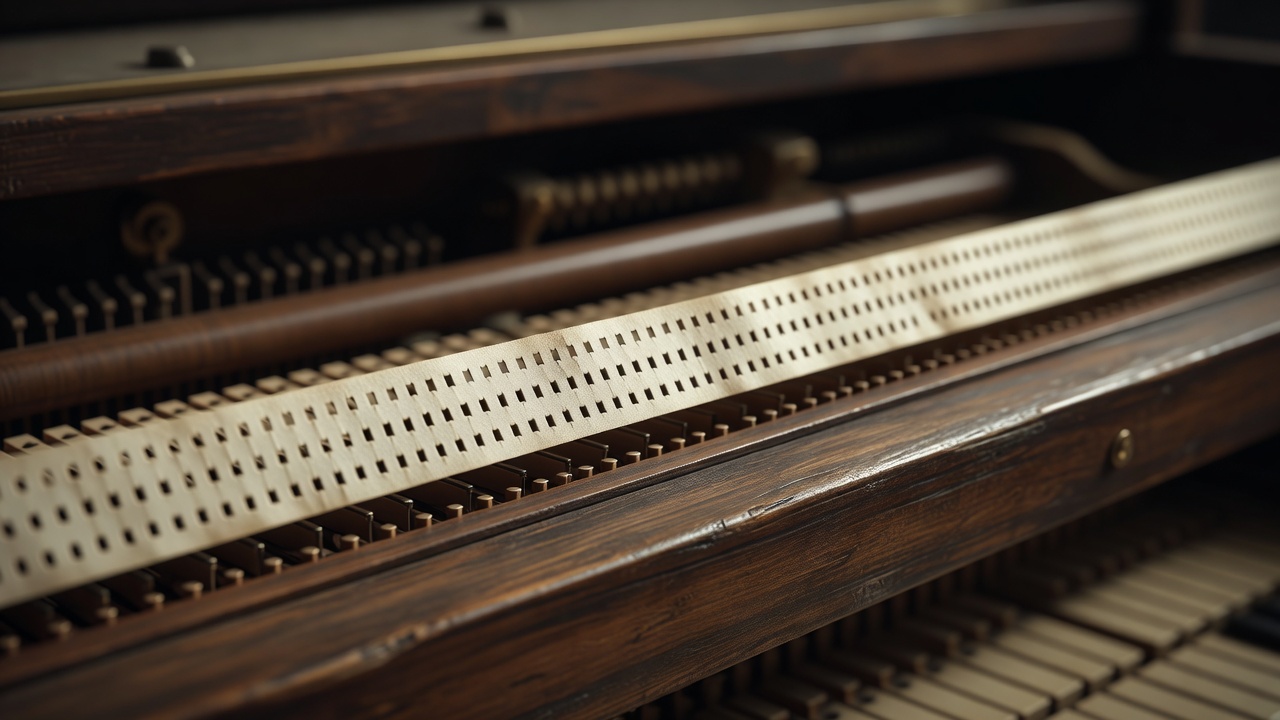
Close-up of a perforated paper music roll threading over a wooden tracker bar
Act Three · The orchestra pit

Act Three: The Band Organ

A one-machine marching band, powered by air and read from a roll of punched paper.

The overture

Close your eyes at a historic carousel and the picture still arrives: a snare drum rattling, a bass drum thumping the beat, pipes carrying a march or a waltz, and a bright glockenspiel line sparkling on top. None of it is recorded. It is being played live, right now, by a machine roughly the size of a wardrobe, usually housed in a painted case near the centre of the platform.

That machine is a band organ, built specifically to be loud enough for outdoor crowds and tough enough for a season of daily use. In America, the name most closely tied to the sound is Wurlitzer.

How it plays

A band organ is a pneumatic instrument. A bellows, once cranked by hand and later driven by an electric motor, supplies a steady stream of air. A perforated paper roll unwinds across a tracker bar, a strip with a row of small holes. Wherever a perforation passes over a hole, air flows through, triggering a valve that sounds a pipe, strikes a drum or rings a bell. The holes in the paper are, in effect, the score.

Different organ models read different roll formats. Wurlitzer's Style 165 band organ plays the "165 roll," and specialist roll arrangers still cut new ones today. Collectors also know the 125 and 150 roll families, each tied to particular instruments.

The Rudolph Wurlitzer Company

Wurlitzer began as a German-American musical instrument business and became famous for automatic instruments. Its band organs were built in North Tonawanda, New York, the same small city where the Allan Herschell Company built carousels. The two industries grew up side by side, and a Herschell machine with a Wurlitzer organ was a common pairing at American parks.

Pull quote
The holes in the paper are the score. Air is the musician. The carousel is simply the dance floor.
On the tracker bar

What's inside the case

Open the back of a band organ and you find a small orchestra arranged for air: rows of wooden and metal pipes imitating trumpets, trombones, flutes and violins; a snare and a bass drum with beaters on pneumatic arms; often a cymbal; and a set of bells or a glockenspiel. The ornate front, painted with scenes and framed by carved scrollwork, sometimes includes moving figures that strike bells or conduct in time.

The repertoire

Classic rolls lean on marches, waltzes, two-steps and popular songs of their day: Sousa marches, Strauss waltzes and Tin Pan Alley tunes. Because rolls can still be arranged and cut, modern pieces sometimes slip in, but on a historic machine you will mostly hear music that was in the air when the carousel was new.

The European cousins

Band organs came to America from the European fairground tradition. Builders such as Gavioli in Paris and Gebrüder Bruder in Waldkirch, Germany, made enormous instruments, many played from folded cardboard "book music" rather than rolls. American makers adapted the idea, favouring compact roll-played designs suited to parks.

Listening well

To hear a band organ properly, stand outside the platform on the side where the organ faces, not on the ride itself. You will catch the drums' attack and the brass-like pipes clearly. Watch the roll if you can see it: the paper creeping across the tracker bar is the most honest piece of stage machinery you will ever meet. At Glen Echo, the Wurlitzer has been restored to keep this music going; at many parks, volunteers from groups like the Carousel Organ Association of America help keep old instruments in tune.